In 2012 it was the oppressed and ignored women of Rojava who approached the Assad regime’s soldiers and, almost without a shot being fired, progressively took over Northern Syria[1]. The YPJ women’s army was born. This incredibly fierce and impressively strategic women’s army then very convincingly overcame ISIS on the battlefield creating serious long-term doubts about whether or not a woman’s place is indeed, in the kitchen.
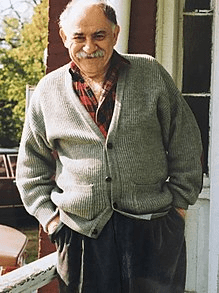
One of the many reasons I like Murray Bookchin is that he is so uncompromisingly optimistic about humans. He insists on a re-evolution of personality-full local village community life with liberatory organizational structures and widespread appropriate use of technology, an aspiration that he called Social Ecology[7][8]. Bookchin passed away in 2007 unfortunately, shortly after receiving a letter from a Kurdish political prisoner detained on the prison island of İmralı in Turkey. The letter explained that they were about to start a revolution based entirely on Bookchin’s ideas[9]. That prisoner was Abdullah Ö****n, the self-declared “student of Bookchin” and spiritual leader of the YPJ. He is still on that island writing books that inspire the revolution today.
Throughout Ö****n’s and Bookchin’s work and underpinning this women’s revolution is the rejection of Patriarchy and its ways of thinking: Domination, Positivism[3] and Instrumentalism[7]. Positivism is the triumphantly efficient and psychologically brutal categorization, homogenization and cold objective organisation of reality, society and “Human Resource” (new-speak for “people”). It is the destruction of all subjective character and personality in human life and it does not accept other doctrines.

A simplistic agricultural example of the psychological difference between Social Ecology and Positivist-Instrumentalism is Permaculture seed bombing vs. Modern European mono-culture farming. Seed Bombing is when we produce lots of small balls of clay, each about half the size of a grenade, impregnated with our favorite vegetable seeds and throw them all over the place. And Nature grows the food forest how it chooses to. Social Ecologists do not “own” Nature, but are instead a humble part of it. Positivist-Instrumentalist farming instead works at a huge National scale, placing identical plants all in straight lines, chemically fertilizing the soil to make it homogeneous and artificially maximizing short-term production. Instrumentalist farmers think that they “own” and “grow” the plants, not Nature. These attitudes apply at a social level just as fiercely as they do with agriculture. Nation-States have this same Positivistic attitude toward their citizens[3] as the centuries of suffering of the Kurds can testify[1][4][5][6].
The social process that Ö***n put in place to allow Social Ecology to flourish is called Democratic Confederalism[6]. The highest authority in Democratic Confederalism is the local community meeting. Nation-States and Nationality are rejected as patriarchal and positivist: “Nationalism, as a positivist religion, aggravates social problems more than do traditional religions”[3]. Thus society is free to organically develop its roles and structures again, without barriers, from the new values and practices of the people. These local communities are politically, economically and socially autonomous, independent and interlinked. And structurally heterogeneous, which brings all of reality crashing down for the red blooded Positivists who need a single fixed social model to apply to all their “human resource”. But citizens can clearly learn to govern themselves much better than they can decide which social model to vote for. Full supply chain production is also re-localized, from mining to factories to organisation to outlets, with smaller industrial facilities in every community and variety of work, instead of large scale national industry and strict specialization[2]… which again has the Positivists frothing at the mouth as they fumble around for their solar powered Economics slide rulers. Ö***n warned that “Objectivity leads to a more dangerous dogmatism than Subjectivity”. So, these localized structures recreate the intimate face-to-face subjective organic community fabric of village society and democracy so critically important in Bookchin’s writings[7][8], whilst enjoying today’s wealth of technological advances and ethical hindsights[10].
In reality the embargo imposed by “Turkey”[19] has prevented Rojava developing the necessary technologies to split up the large corporate entities that still supply and control most of its infrastructure. 90% of Rojava’s economy is still large scale Capitalist[4]. Kurdish society is also violently fractured with competing political parties, comprising almost always only men, demanding Rojavan elections and a parliament. Accusations of authoritarianism against the PYD (Democratic Union Party), who enabled the Democratic Confederalist process, led to counter protests and some violence[4].
Family blood feuds are common in Rojava. When there is a conflict the local Rojavan Peace and Security committees and Rojavan police (Asayish) organise both parties’ families to resolve the problem together. Instead of objectively quantifying and punishing the act, both are asked to understand the subjective specific causes and design rehabilitations. This is the traditional Kurdish conflict resolution system and two-thirds of conflicts in Rojava are resolved this way[1]. Because the results of this process will obviously differ for each human context, Rojava is under fire from human rights organisations claiming it has no objective justice system[1].
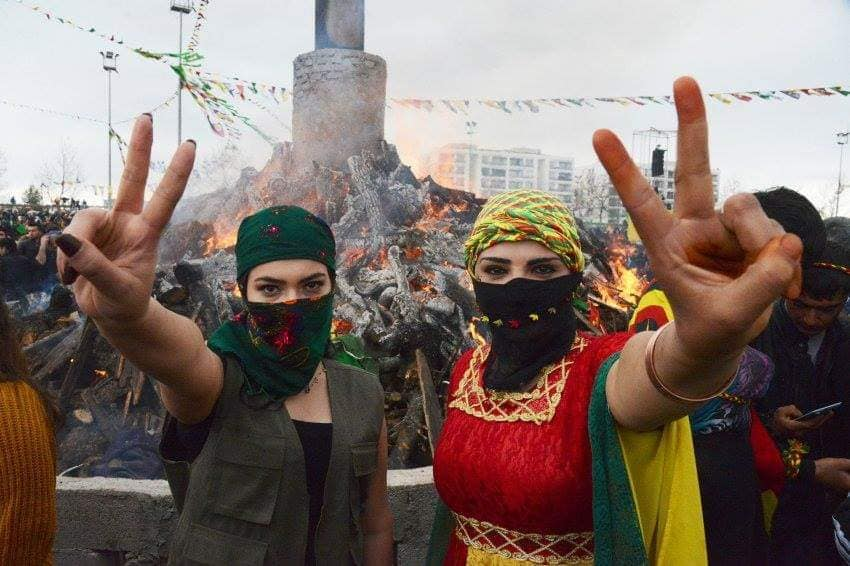
Popular sentiment, however, is clearly with the womans armies and its Democratic Confederalism. Full structural change has happened with regards to the role of women[1]. Refugees also flood into Rojava because it is one of the safest places in the region[13][14][15]. The Kurds do not have a strong sense of Nationality[3] so all people’s traditions are welcome and energetically celebrated[11]. Local communities in Rojava do now have the authority, organisation, variety, and thus innovation, needed to progressively develop this new society[1][5]. Next door in northern Kurdistan the Turkish government’s positivist assimilation strategy of emptying Kurdish villagers into cities is constantly frustrated as the Kurds are visibly “treating the city [neighborhoods] like villages”[5] and progressively developing Democratic Confederalist structures. In Baghdad also massive protests are erupting as the second Arab spring gets underway and this time huge numbers of women are present[12][16][17].
Rojava might be the last chance we have of re-evolving human society onto a more human and rational path but, as always, it struggles[18] to the whistling sound of Positivism’s new and improved BombsTM.
References
[1] Revolution in Rojava, Anja Flach, Ercan Ayboga, and Knapp Michael, 2016
[2] Toward a Liberatory Technology, Murray Bookchin, 1965
[3] The Political Thought of Abdullah Ö***n: Kurdistan, Woman’s Revolution and Democratic Confederalism, Abdullah Ö***n. 2017
[4] Rojava, Schmidinger, 2018
[5] Democratic Autonomy in North Kurdistan by TATORT, 2013
[6] Prison Writings III, Abdullah Ö***n, 2012
[7] The Ecology of Freedom, Murray Bookchin, 1982
[8] Urbanization Without Cities, Murray Bookchin, 1992
[9] Bookchin, Ö***n, and the Dialectics of Democracy, Janet Biehl, 2012
[11] Telephone interviews at Christmas time, 2019
[12] https://www.bbc.com/news/world-middle-east-50756004
[13] What the Syrian Kurds Have Wrought. The radical, unlikely, democratic experiment in northern Syria, Si Sheppard, 2016
[14] Rojava hosts thousands of displaced Iraqi civilians as war on ISIS intensifies, ARA News, 17 October 2016
[15] Syrian Kurds provide safe haven for thousands of Iraqis fleeing ISIS, ARA News, 13 July 2016
[16] https://www.aljazeera.com/news/2019/12/women-frontline-iraq-uprising-191205085107123.html
[17] https://www.independent.co.uk/news/world/middle-east/iraq-protests-women-streets-death-torture-revolution-tahir-square-a9213976.html
[18] https://www.bbc.com/news/50125405
Notes
[10] By this I mean understandings of sexism, racism, etc. etc. etc.
[19] When analyzing Rojava, the validity of the concept of a “Nation” comes into question as well as the analysis of history and the present by Nation. As Ö****n said: “The concept of Israel and Arab, as positivist [homogeneous] nation concepts, are themselves mechanisms that generate problems. The more one attributes meaning and value to being Israeli and Arabic, the more the question becomes complicated. This is because neither concept, Israeli or Arab, stands up to reality and gives us true meaning.” It would be a strategic mistake to regard “Rojava’s” enemy as “Turkey” or “ISIS”. The abstract concept that is now “Rojava” will be attacked by Patriarchal people and concepts, externally and internally. See the theories of anti-essentialism to dig more deeply into these ideas.

